
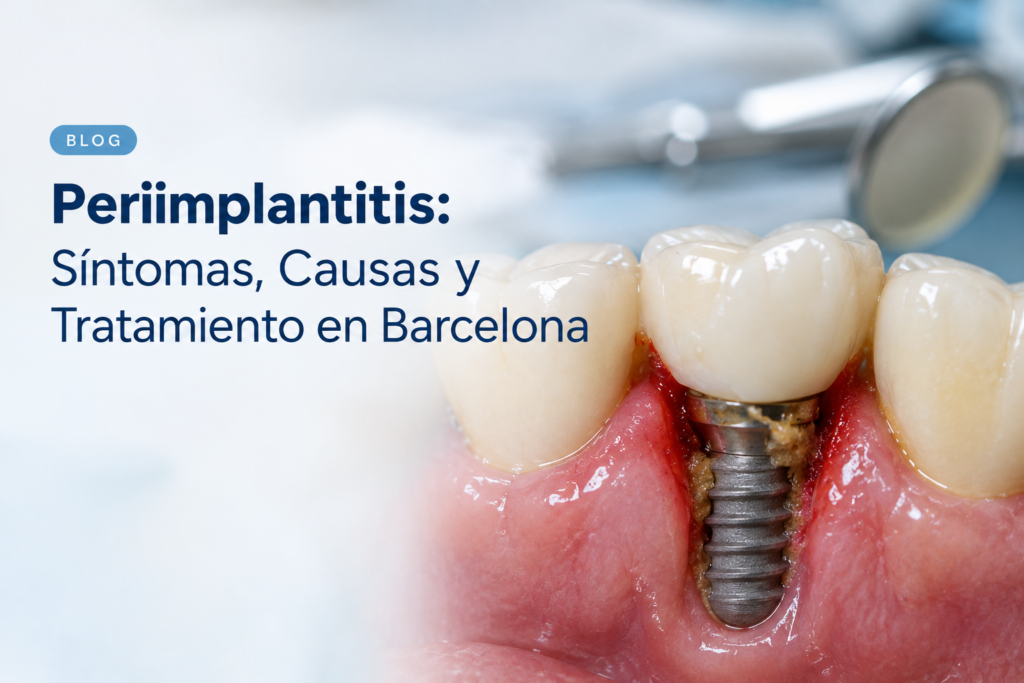
If you notice discomfort, swelling or bleeding around an implant you’ve treated like just another tooth, it’s natural to wonder: could I lose it? The short answer is: it’s possible, but in most cases entirely preventable if caught early. That “early” is what this whole article is about.
Peri-implantitis: a clear definition
Peri-implantitis is an infectious, inflammatory disease affecting the tissues around an osseointegrated dental implant, with one feature that makes it particularly tricky: it causes progressive loss of the bone supporting the implant. Unlike simple gum inflammation, peri-implantitis advances silently and, left untreated, can end in implant mobility and total loss.

It’s worth distinguishing it from its earlier stage, peri-implant mucositis, which is reversible because it only affects the soft tissue (the mucosa), with no bone destruction yet. Peri-implantitis is, in practice, what happens when mucositis goes untreated and progresses into the bone.
| Peri-implant mucositis | Peri-implantitis | |
|---|---|---|
| Tissue affected | Mucosa (gum) only | Mucosa + supporting bone |
| Bleeding on probing | Yes | Yes, often with suppuration |
| Bone loss | No | Yes, progressive |
| Reversibility | Reversible with treatment | Requires active treatment; lost bone doesn’t regenerate spontaneously |
| Risk of implant loss | Low if treated | High if untreated |
How common is peri-implantitis? The data most clinics don’t explain
One reason we emphasize regular check-ups so strongly is that peri-implantitis isn’t a rare complication. The epidemiological data, though it varies by study and population, is compelling:
| Study / source | Population | Peri-implantitis prevalence |
|---|---|---|
| Rodrigo D. et al., 2018 (SEPA, Spain) | 275 patients / 474 implants | 24% of patients (27% with mucositis) |
| Sixth European Workshop on Periodontology consensus | International systematic review | 28-56% of patients depending on diagnostic criteria |
| Mombelli et al. (review) | Meta-analysis of previous studies | 20% of patients / 10% of implants |
| Schmidlin et al., 2012 | 5- and 10-year follow-up | 5-9% at 5 years; up to 20% at 10 years |
A Spanish epidemiological study led by the Spanish Society of Periodontology (SEPA), evaluating 474 implants in 275 patients, found that the prevalence of peri-implant disease in the Spanish adult population is 51%, split between 27% mucositis and 24% peri-implantitis (Rodrigo D. et al., Journal of Clinical Periodontology, 2018). In other words: roughly 1 in 4 people with implants will develop peri-implantitis at some point. This isn’t a clinical anecdote — it’s a statistical reality every implant patient should be aware of, especially if it’s been years since their last check-up.
Causes: why bone is lost around an implant
Peri-implantitis is fundamentally bacterial in origin — a biofilm (plaque) colonising the implant surface much as it would around a natural tooth — but several factors multiply the risk, as also noted in the consensus of the Sixth European Workshop on Periodontology:
- History of periodontitis. By far the most well-documented risk factor: the bacteria involved in gum disease are largely the same ones that colonise a diseased implant.
- Poor oral hygiene. Inadequate brushing and interdental cleaning around the implant allows plaque to build up in hard-to-reach areas, especially under poorly designed screw-retained or cemented crowns.
- Smoking. Reduces blood supply to the tissues and impairs the local immune response, hindering healing.
- Poorly controlled diabetes. Disrupts white blood cell function and slows healing of peri-implant tissues.
- Residual excess cement left after placing the crown, which acts as a bacterial reservoir if not fully removed.
- Poor prosthetic design, which makes everyday home cleaning difficult.
- Lack of regular maintenance, which prevents early signs from being caught while they’re still reversible.
Why early diagnosis is what saves the implant
Here’s the point we most want every implant patient to take away: peri-implantitis usually doesn’t hurt in its early stages. Bone has no nerve endings to signal its progressive loss, so many patients only notice a problem once there’s mobility, visible gum recession or even pain — by which point the bone damage can already be considerable.
Early diagnosis rests on three pillars that can only be assessed in the clinic:
- Peri-implant probing. Measuring pocket depth around the implant and checking for bleeding on probing — one of the earliest and most reliable signs of active inflammation.
- Comparative periapical or panoramic X-rays. Lets us assess progressive bone loss by comparing with previous X-rays, something a patient can never detect on their own.
- Checking stability and absence of suppuration, indicators that infection may be active even without obvious pain.
Catching the disease at the mucositis stage, or an early-stage peri-implantitis with minimal bone loss, radically changes the prognosis: at these stages, non-surgical treatment (mechanical debridement, decontamination of the implant surface, hygiene adjustments) is usually enough to stop progression. When diagnosis comes late, with advanced bone loss, the options narrow to regenerative or resective surgery, with a less predictable prognosis, and in the most advanced cases, implant removal.
Prevention: what actually makes the difference
- Regular check-ups (at least once a year, or as often as your dentist recommends based on your risk profile), including probing and comparative X-ray monitoring.
- Implant-specific interdental hygiene: interproximal brushes or a water flosser, adapted to the shape of the prosthesis.
- Managing modifiable risk factors: quitting smoking and keeping diabetes well controlled are the two interventions with the strongest documented impact.
- Regular professional maintenance, removing biofilm from areas home hygiene can’t reach.
- Checking the prosthetic fit, to rule out excess cement or designs that make cleaning difficult.
These are the same measures we recommend for preventing periodontitis in natural teeth, since both diseases share a common bacterial origin.
Treatment by disease stage
| Stage | Clinical finding | Typical treatment approach |
|---|---|---|
| Peri-implant mucositis | Bleeding on probing, no bone loss | Non-surgical debridement + reinforced hygiene |
| Early peri-implantitis | Mild bone loss, moderate pockets | Surface decontamination, possible laser or local antimicrobial therapy |
| Moderate-advanced peri-implantitis | Significant bone loss, early mobility | Resective or regenerative surgery depending on the bone defect |
| Severe peri-implantitis | Extensive bone loss, clear mobility | Implant removal and assessment of subsequent rehabilitation |
Proper follow-up of dental implant treatment from day one significantly reduces the risk of reaching the more advanced stages.
What to do if you notice discomfort or bleeding around your implants
If this is your situation, the most important message in this article is this: don’t wait for it to hurt. The fact that you feel no pain doesn’t mean there isn’t an active process destroying the bone supporting your implant. Booking a check-up with peri-implant probing and a comparative X-ray is the only way to know, with certainty, what stage the process is at and how much room there still is to act.
At Clínica Blasi, in Barcelona, we assess the condition of your implants with a diagnostic protocol specific to peri-implant disease, always comparing against the initial bone level after placement. The earlier the inflammation is caught, the simpler, more conservative and more predictable the treatment — which also directly affects how long your dental implants last in the long run, and the cost of maintenance, which you can read more about on our periodontal treatment page.
Frequently asked questions about peri-implantitis
Can peri-implantitis be cured?
At the mucositis stage (no bone loss) it’s fully reversible with treatment. Once peri-implantitis has set in, lost bone doesn’t come back spontaneously, but progression can be stopped and, in many cases, part of the bone can be regenerated through surgery, saving the implant.
How do I know if I have peri-implantitis or just temporary inflammation?
The only reliable way is a check-up with peri-implant probing and an X-ray compared with the one taken when the implant was placed. Bleeding on probing and deep pockets are what the professional evaluates; without these tests, it’s not possible to tell a reversible mucositis from active peri-implantitis with bone loss just by looking.
Can peri-implantitis be painful?
Almost never in its early stages. Bone doesn’t hurt as it’s lost, which is why many patients notice nothing until there’s mobility, gum recession or suppuration — by which point bone loss is already considerable. Discomfort or bleeding when brushing are warning signs that shouldn’t be left until pain shows up.
How often should I have my implants checked?
At least once a year, though if you have a history of periodontitis, smoke, or have diabetes, your dentist may recommend check-ups every 6 months, since these factors significantly increase the risk.
Can an implant be lost to peri-implantitis?
Yes. If bone loss progresses untreated to the point of compromising implant stability, the resulting mobility usually means it has to be removed. This is exactly what early diagnosis aims to prevent: the sooner it’s caught, the lower the risk of reaching this point.
Can peri-implantitis spread to neighbouring implants or teeth?
It doesn’t “spread” in a strict sense, but the bacteria involved are shared with gum disease, so an implant with active peri-implantitis and a tooth with untreated periodontitis can feed into each other within the same mouth. That’s why general periodontal control is part of any implant maintenance protocol.
