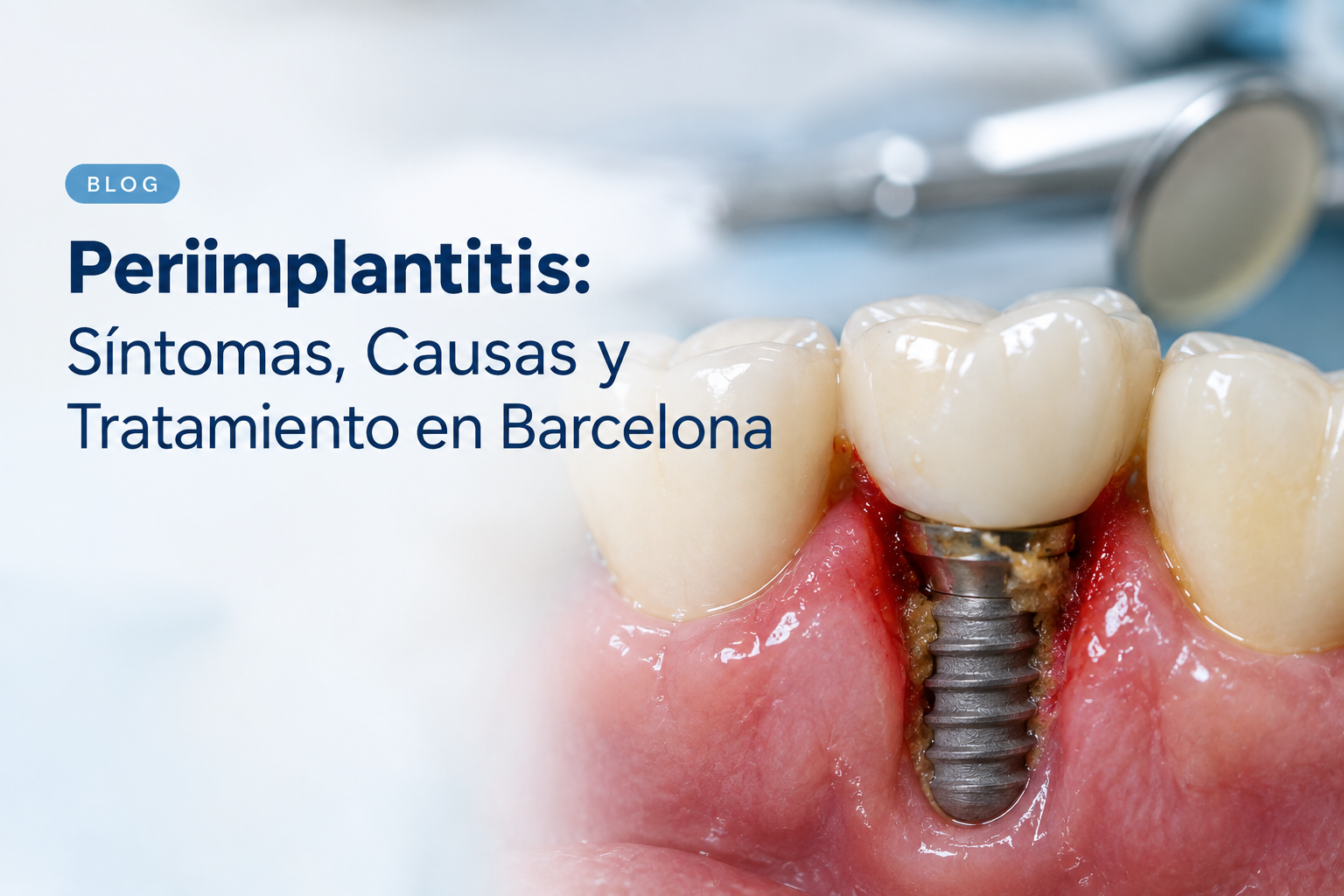

Immediate loading dental implants make it possible, in suitable cases, to leave the clinic on the same day with your implant and a provisional crown in place, so you never have to spend months with a visible gap in your smile.
“I don’t want to go months without a tooth”: a more common worry than it seems
At Clínica Blasi we hear this phrase almost every week: “The idea of showing a gap for months when I smile or speak in public terrifies me.” It is a completely legitimate concern.
For decades, the standard implant protocol required placing the implant, waiting three to six months for the bone to integrate fully (osseointegration), and only then fitting the definitive crown.
That waiting period, especially when it affects a tooth that shows when you smile, had a real impact on the social and professional lives of many patients.
The good news is that dentistry has moved on. Today, in correctly selected cases, it is possible to place the implant and a functional, natural-looking provisional crown at the same appointment.
This technique is known as an immediate-loading implant, and it is one of the areas where the Implantology and Surgery team at Clínica Blasi, in Barcelona, has the most experience.
In this article we explain, step by step, what the protocol involves, who can benefit from it and how immediate loading differs from traditional delayed loading.
What are immediate loading dental implants?
An immediate-loading implant is one that receives a crown (provisional or, in some cases, definitive) on the same day as the implant surgery, instead of waiting several months for the bone to heal before “loading” it with chewing function.
One point is worth clarifying, as it often causes confusion: the crown placed on the same day is usually provisional, made of a lighter material and with a reduced bite (occlusal) adjustment, so that the newly placed implant is not subjected to excessive force while the bone integrates around it.
After a few months, once osseointegration is complete, that provisional crown is replaced by the definitive one, usually ceramic, with the final fit and aesthetics.
What the patient gains with this protocol is not “skipping” the biological healing process, which still takes place, but not having to go through it without a visible tooth.

The protocol, step by step
1. Study and planning (before surgery)
Immediate loading is not suitable for every case, so the preliminary study phase is decisive. At Clínica Blasi this analysis includes:
- Intraoral scan and CBCT (3D dental CT): to assess the amount and quality of the available bone, as well as the exact position of anatomical structures.
- Assessment of expected primary stability: the most decisive factor in being able to load an implant on the same day is that, once placed, it is firmly anchored in the bone from the very first moment.
- Digital smile design and design of the provisional crown: when the implant affects an aesthetic area, the shape, size and colour of the provisional crown are planned in advance so that it is ready on the same day.
2. Extraction (if necessary) and implant placement
In many cases, immediate loading is combined with an immediate post-extraction implant: the damaged tooth is removed and, during the same procedure, the implant is placed in the same socket, minimising the number of surgeries and the total treatment time.
The implant is inserted following the prior planning, under local anaesthetic, and the team measures the primary stability achieved at that moment.
This is the clinical decision point: immediate loading goes ahead only if stability is sufficient; otherwise, the conventional delayed protocol is chosen so as not to compromise the implant’s integration.
3. Fitting the provisional crown in the same session
If primary stability is adequate, a provisional crown, previously designed or adjusted at the appointment itself, is screwed onto the implant. This crown:
- Immediately restores aesthetics, which is especially important for front teeth.
- Allows basic chewing function to be recovered, though with precautions (avoiding very hard or fibrous foods during the first few weeks is recommended).
- Is adjusted with a “relieved” bite, that is, without full contact with the opposing teeth, to protect the implant during the bone healing phase.
The patient leaves the clinic the same day with a visible tooth, rather than with an empty space or a removable provisional prosthesis.
4. Osseointegration period
Over the following 2 to 4 months (the exact timeframe depends on the treated area and the patient’s bone), the implant integrates biologically with the surrounding bone.
Regular check-ups are carried out to monitor the soft tissues and confirm there are no complications.
5. Fitting the definitive crown
Once osseointegration is confirmed, the provisional crown is replaced with the definitive one, taking colour and shape records again to ensure the best long-term aesthetic and functional result.
Who is a candidate for an immediate-loading implant?
Not all patients are candidates, and it is important to be transparent about this. Factors that tend to favour immediate loading include:
- Good bone density in the area to be treated.
- No active infection at the time of surgery.
- High primary stability of the implant at the time of placement.
- Controlled habits, such as being a non-smoker or having smoking well managed, as it affects healing.
- No severe, uncontrolled bruxism (teeth grinding), which could subject the provisional crown to excessive loads.
In patients with insufficient bone, active infections or low primary stability, the delayed-loading protocol remains the safest and most predictable option.
The final decision is always made after an individual assessment, never in a generic way.
Advantages over the traditional protocol: what the data say
One of the biggest fears about immediate loading is whether “loading” the implant so soon compromises its long-term success. The data from recent scientific articles are reassuring when the case is well selected:
| Indicator | Data from the scientific literature | Reference |
|---|---|---|
| Survival of single immediate-loading implants in the maxillary aesthetic zone | 97.7% (weighted mean rate) | Hamilton et al., 2023, Clinical Oral Implants Research |
| Survival with low (≤ 35 Ncm) vs. high (> 35 Ncm) insertion torque | Comparable survival rates in both groups | Darriba et al., 2023, Journal of Clinical Periodontology |
| Implant failure with ISQ > 60 at the time of loading | 0% failures in the ISQ > 60 group, compared with 19% failures with ISQ < 60 | Data collected in Osstell clinical guidelines based on 1,500+ references |
| Micromovement tolerated without compromising osseointegration | Between 50 and 150 microns | Immediate loading implants: review of the critical aspects, 2017 (PMC) |
These data confirm a central idea of the protocol: immediate loading is not a “faster but riskier” technique, but a protocol with objective, measurable criteria that, when met, offers implant survival comparable to that of the traditional delayed protocol.
Added to this are the advantages patients experience directly:
- Reduced psychological and social impact: you avoid the period without a visible tooth that worries patients so much.
- Fewer surgical interventions in many cases, by combining extraction and implant placement in the same appointment.
- Earlier functional recovery, with shorter dietary restrictions than with a provisional removable prosthesis.